

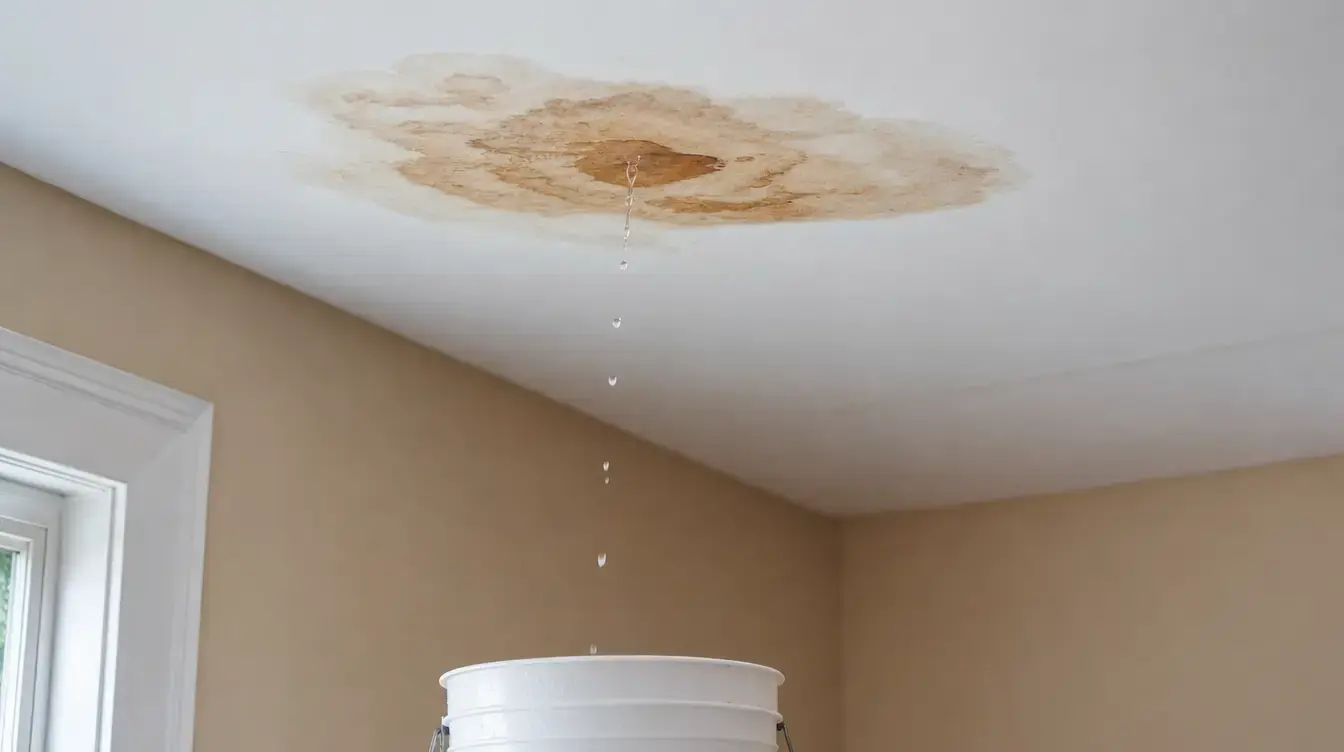
If your roof is leaking right now, do three things fast. Move anything valuable out of the way, put a bucket or container under the drip to catch the water, and if the ceiling is bulging, poke a small hole to let the water drain in a controlled spot. Then call a roofer. Below we walk through each step in order, how to find the source, and how to know when a leak is a true emergency.
Step 1: Protect your home and family first
Before you worry about the roof itself, deal with the water inside. Move furniture, electronics, and anything that can be damaged away from the drip. Lay down towels or a tarp to protect the floor. If water is anywhere near light fixtures, outlets, or your electrical panel, stay clear and shut off power to that area at the breaker if you can do so safely. Water and electricity together are dangerous.
Step 2: Contain the water
Put a bucket, trash can, or any wide container under the active drip. Drop an old towel in the bottom to cut down on splashing. If the leak is spread across an area, a plastic tarp funneling water into a single container works better than chasing several drips.
If the ceiling is bulging
A sagging, water filled bulge in your ceiling is holding a pocket of water that will eventually let go on its own, usually across a wider area and at the worst moment. Place a bucket underneath, then take a screwdriver or pencil and poke a small hole at the lowest point of the bulge. That sounds wrong, but it drains the water in one controlled spot and relieves the pressure so the whole ceiling does not collapse. It is the right move.
Step 3: Try to find where the water is coming in
If it is safe and dry enough to get into your attic, take a flashlight and look. You are searching for the spot where water is actually entering, which is often not directly above the stain on your ceiling. Look for these signs.
- ▸Wet or dark streaks running down the underside of the roof deck or along the rafters.
- ▸Damp or matted insulation.
- ▸Daylight coming through where it should not.
- ▸Water trails that lead back uphill to a higher entry point.
Do not climb onto the roof during or right after a storm. A wet roof is slick, and a fall is far worse than the leak. Finding the entry point from inside is plenty for now.
Why water shows up far from the real leak
This is the part that fools most homeowners. Water rarely drips straight down from the hole in the roof. It enters at one point, then travels along the underside of the decking, down a rafter, or across the top of a ceiling until it finds a low spot or a seam to drip from. The stain on your ceiling can be several feet away from the actual failure on the roof.
That is exactly why patching the spot above a ceiling stain so often fails. The patch covers a symptom, the real entry point is still open, and the leak comes right back with the next rain.
When a roof leak is an emergency
Most leaks can wait a day or two for a scheduled repair. Some cannot. Treat it as an emergency and get help right away if you see any of the following.
- ▸Water is pouring in rather than dripping.
- ▸A ceiling is sagging badly or starting to come down.
- ▸Water is reaching electrical fixtures, outlets, or your panel.
- ▸A large section of the roof is open after storm damage or a fallen tree.
- ▸The leak is over a finished, lived-in space and spreading fast.
In those cases the goal is to stop the water and stabilize things now, then plan the permanent fix. Many roofers, including us, can place an emergency tarp to buy you time until a full repair can be done safely.
How CER finds the real source
Finding the true entry point is where experience and a real inspection pay off. CER Roofing employs a HAAG Certified Inspector, which means our leak diagnosis follows a trained, systematic process instead of a guess. We trace the water back from the inside, then inspect the most common failure points on the roof itself.
- ▸Flashing around chimneys, skylights, and wall transitions, which is one of the most common leak sources.
- ▸Pipe boots and vent penetrations, where the rubber seal cracks over time.
- ▸Valleys where two roof planes meet and channel a lot of water.
- ▸Damaged, lifted, or missing shingles.
- ▸Nail pops and worn sealant.
By starting at the entry point and working back to the cause, we fix the leak once instead of chasing the stain. That is the difference between a repair that holds and a patch that fails by the next storm.
Repair or replace?
Not every leak means a new roof. A single failed pipe boot or a section of damaged flashing is usually a straightforward repair. A typical roof repair runs roughly 500 to 1,800 dollars as a ballpark, with the exact price set after we see it in person. Replacement makes more sense when the roof is near the end of its life, when leaks are showing up in several places at once, or when the decking underneath has rotted from long term water exposure.
An honest inspection answers this for you. If a repair will hold, we will tell you, and if it will not, we will explain why so you are not paying twice for the same problem.
A patch over a ceiling stain almost always fails. The fix that lasts starts at the real entry point, which is usually somewhere else entirely.
CER Roofing Contractors has served Iredell and Rowan County since 2020, including Mooresville, Statesville, Salisbury, Troutman, Kannapolis, Lake Norman, and Winston-Salem. We carry a 5.0 star rating across 85 Google reviews, an A+ BBB rating, and a HAAG Certified Inspector on the team to find your leak right the first time.
Got a leak? Call CER Roofing at (704) 902-6128 for a free on-site inspection and a real fix at the source, not just a patch over the stain.
Related CER services
CER Roofing Contractors, LLC
5.0-star rated (85 reviews), GAF & HAAG certified roofing across Iredell & Rowan County, NC since 2020.
(704) 902-6128